


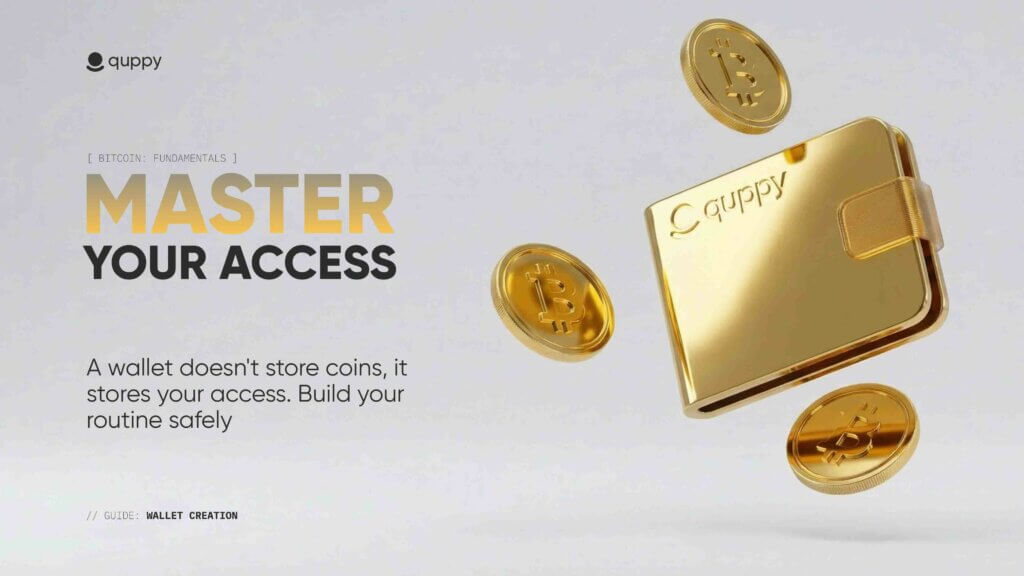
If you’re learning crypto, it’s only a matter of time before you ask how to create a bitcoin wallet. Bitcoin can’t be “kept” in a normal bank account, and it doesn’t sit inside an app like photos in a gallery. What you actually manage is access, your ability to approve a transaction on the blockchain.
This guide explains how a crypto wallet works, which type to choose, and how to set one up without the common beginner mistakes. We’ll keep it practical, calm, and focused on real safety.
Why having a Bitcoin wallet is essential
A Bitcoin wallet is essential for one simple reason: Bitcoin is designed so that ownership is proven by cryptography, not by a company’s internal database.
With a wallet, you can:
- Receive btc directly (not “through someone else’s account”)
- Send btc when you decide, without asking permission
- Verify your balance by checking activity on the blockchain
- Choose how much control you want (full self-custody vs relying on a provider)
Without a wallet, you’re either not using Bitcoin at all, or you’re using it through a third party that can set rules for you. That may be fine for some people, but it’s still a dependency you should understand.
Understanding Bitcoin Wallets: Core Concepts
Before you create anything, you need a small set of ideas that will protect you from confusion later.
Private key
A private key is the secret that proves you can spend btc. It’s not like a password you can reset. If someone gets your private key, they can authorize a transaction and move your funds. If you lose it and you have no backup, access can be gone permanently.
Public address
A public address is what you share to receive btc. It’s safe to give out, but it must be accurate. One wrong character can send funds somewhere you don’t control.
Seed phrase
Most modern wallets don’t show you private keys directly. Instead, they generate a seed phrase (often 12 or 24 words). This phrase can recreate your wallet and restore access on a new device.
Think of it as the master backup. If someone sees it, they can restore your wallet elsewhere.
UTXO model
Bitcoin doesn’t track balances like a bank. It uses UTXOs (Unspent Transaction Outputs). In beginner terms:
- Your wallet “finds” pieces of btc assigned to your addresses
- If those pieces haven’t been spent, they count toward your balance
- When you send btc, your wallet selects UTXOs and creates a new transaction
This is why your wallet may show “change” coming back to you after a send, it’s part of how UTXOs work.
Non-custodial vs. custodial
This is the biggest choice you make:
- Non-custodial wallet: you control the keys (and the seed phrase).
- More control and independence
- More responsibility for backups and safety
- Custodial wallet: a company holds the keys for you.
- Often easier to start
- You rely on their policies, uptime, and security
Neither is “always best.” The best fit depends on your goals and how confident you feel managing backups.
Types of Bitcoin Wallets
Different wallet types are really different key storage styles. Here are the main categories you’ll see.
Hardware wallets
Hardware wallets keep keys on a dedicated device, designed to stay isolated from everyday malware.
Best for
- Long-term holding
- Larger balances
- People who want strong protection from online threats
Trade-offs
- Costs money
- Requires careful setup and safe physical storage
Desktop wallets
Desktop wallets run on a computer and can offer detailed controls.
Best for
- People who want more visibility and control
- Users managing multiple wallets or advanced settings
Trade-offs
- A compromised computer can become a real risk
- Less convenient for quick payments
Mobile wallets
Mobile wallets are popular because they’re always with you.
Best for
- Beginners who want a simple daily wallet
- Small everyday balances
- QR-code payments and fast transfers
Trade-offs
- Phones are exposed to phishing and fake apps
- Losing your phone is a crisis if your seed phrase isn’t backed up properly
Web/browser wallets
These wallets live in a browser environment (sometimes as extensions, sometimes web-based).
Best for
- Users who want quick access
- People using web tools frequently
Trade-offs
- Browser threats: malicious extensions, fake sites, lookalike pages
- Higher phishing exposure if you click careless links
Paper wallets
A paper wallet is an offline record of keys or seed phrases, stored physically.
Best for
- Very specific offline storage strategies
Trade-offs
- Easy to lose, damage, or expose
- Easy to create incorrectly
- Not beginner-friendly for active use
Choosing the Right Wallet Type
The best way to choose a wallet is to pick it by use case, not by hype.
For beginners
Most beginners do best with a simple mobile wallet or a beginner-friendly custodial option while learning. The priority is avoiding mistakes.
Good beginner features:
- clear backup prompts
- simple send/receive screens
- readable fee and confirmation screens
For long-term HODL
If you plan to hold btc for months or years, consider stronger isolation:
- hardware wallet storage
- careful, redundant offline backups
- minimal “always-online” exposure
Long-term storage should feel boring, in a good way.
For active traders
If you trade often, you may prefer speed and smooth access.
Practical approach:
- keep only “working funds” in a hot wallet
- keep long-term savings in a safer setup
- always test new addresses and networks with a small transfer first
For privacy
Privacy depends on habits as much as tools. Non-custodial wallets can help, but you still need discipline:
- avoid sharing addresses unnecessarily
- separate wallets for different activities when needed
- be cautious about wallet analytics or tracking settings
For businesses
Businesses often need structure and accountability:
- role-based access (who can approve a transaction)
- separation of wallets for operations vs reserves
- documented backup and recovery procedures
- sometimes multisig (multiple approvals to spend)
If you’re handling shared funds, simplicity and clear processes matter more than flashy features.
Step-by-Step Guide: Creating a Wallet
Here’s a beginner-safe process that works for most people.
1) Decide: custodial or non-custodial
Ask yourself:
- Do I want full control of keys?
- Am I ready to store a seed phrase safely?
- Do I need easy recovery through a provider?
If you want independence, choose non-custodial. If you want simplicity and don’t mind relying on a service, custodial may be acceptable.
2) Choose the platform: mobile, desktop, or hardware
Match the wallet type to your goal:
- daily use → mobile
- long-term storage → hardware
- detailed management → desktop
Avoid mixing goals on day one. It’s easier to build a strong setup in layers.
3) Install only from an official source
Fake wallets are one of the most common traps in crypto.
Best habits:
- use official app stores or the official vendor source
- double-check names and publisher details
- avoid downloads from ads, random “review” sites, or social media links
4) Create a new wallet and generate the seed phrase
When the wallet shows the seed phrase:
- write it down offline
- check spelling and word order carefully
- store it somewhere private and protected
Do not
- screenshot it
- paste it into notes
- email it to yourself
- upload it to cloud storage
5) Set protection on the wallet
Even with a seed phrase backup, lock access:
- strong phone/computer passcode
- wallet PIN if available
- biometrics (face/fingerprint) if supported
- avoid using the same password across services
6) Do a “dry run” recovery check
A quiet but powerful step: confirm you understand recovery.
You don’t have to reset immediately, but you should know:
- where the wallet’s restore feature is
- what you would do if the phone disappears tomorrow
Confidence beats panic.
Funding Your Wallet: How to Receive BTC
To receive btc, you need your Bitcoin address.
Steps to receive
- Open your wallet and tap Receive
- Copy the address or use the QR code
- Send it to the person or platform sending you btc
- Wait for confirmations on the blockchain
Beginner tips that prevent pain
- Always verify the address after copying (first and last characters)
- If you’re receiving from an exchange, check whether they require memo/tag fields (Bitcoin usually doesn’t, but platforms can have internal rules)
- Start with a small test amount if it’s your first time receiving to a new wallet
Receiving doesn’t require you to “be online at the right moment.” Once the transaction is confirmed, your wallet will show the funds when it refreshes.
Sending Bitcoin: First Transaction
Sending btc is where beginners most often make mistakes, because it feels final, because it is.
Steps to send
- Tap Send
- Paste the recipient address
- Enter amount
- Choose a fee level (slow/medium/fast, if offered)
- Review everything carefully
- Confirm the transaction
What fees really are
Bitcoin fees are paid to the network for including your transaction in a block. Higher fees usually confirm faster. Lower fees can work fine when the network is quiet, but may take longer when it’s busy.
A smart first send:
- send a small amount
- choose a middle fee option
- confirm the recipient received it before sending more
Common Mistakes to Avoid
Most losses come from predictable errors, not mysterious hacks.
- Not saving the seed phrase
- If the device dies, your btc may be unreachable.
- Storing the seed phrase digitally
- Screenshots and cloud notes are common leak points.
- Installing a fake wallet
- Lookalike apps can steal your seed phrase instantly.
- Sending to the wrong address
- Always copy/paste carefully and verify characters.
- Ignoring the fee screen
- Very low fees can delay confirmations; too high fees can be unnecessarily expensive.
- Keeping all funds in one “hot” place
- For larger amounts, consider splitting: daily wallet vs long-term storage.
If you only adopt one habit: slow down for 15 seconds before you confirm a transaction.
Security Best Practices
Security is not a single setting. It’s a routine you keep repeating.
- Use two layers of protection
- device lock + wallet lock
- Back up seed phrase offline
- private, protected, and not easy to discover
- Keep software updated
- OS updates and wallet updates reduce known vulnerabilities
- Be suspicious of urgency
- scammers love “act now” messages
- Never share seed phrase
- not with support, not with friends, not with anyone
- Separate funds by purpose
- spending wallet for daily activity
- storage wallet for long-term holdings
The goal is simple: make it hard for a mistake to become a disaster.
Quppy Crypto
If you’re learning how to create a bitcoin wallet and you want an environment that feels practical rather than intimidating, Quppy Crypto is designed to help with exactly that. Quppy is a multi-currency wallet and financial app built for everyday crypto routines, clean navigation, readable actions, and a flow that helps beginners stay organized while they learn.
Creating a Bitcoin wallet in Quppy
A beginner-friendly way to approach setup:
- Install Quppy and open the app
- Use a secure device and a strong device passcode.
- Create your wallet space
- Follow the onboarding steps carefully and don’t rush.
- Secure access
- Enable available locks (PIN/biometrics where supported).
- Treat this step as part of “wallet creation,” not an optional add-on.
- Prepare for receiving
- Locate your Bitcoin receiving screen and copy your address.
- Consider doing a small test receive first.
Why Quppy fits Bitcoin beginners
- A clear interface that reduces “wrong button” mistakes during early steps
- A practical approach to everyday wallet use, including receiving and sending flows
- Multi-asset support, so you can expand beyond btc without managing a pile of separate apps
- Cross-platform usability that fits real life: travel, device changes, daily routines
- A balanced experience: beginner-friendly, but still useful as your activity grows
If you want a crypto wallet that feels like a stable tool, not a confusing experiment- Quppy is worth trying.
Download Quppy and start using it today.
Conclusion
Now you know how to create a bitcoin wallet in a way that’s actually safe:
- A wallet doesn’t “store coins”, it stores access.
- The blockchain holds the public record; your keys control spending.
- Your seed phrase is your recovery lifeline, and also the master key.
- The “best” setup depends on your use case: daily convenience vs long-term security.
Start small, do test transactions, and build your routine step by step. And if you want a simple, readable place to manage btc while you learn, Quppy Crypto can be a practical wallet choice that balances everyday usability with security-minded habits.